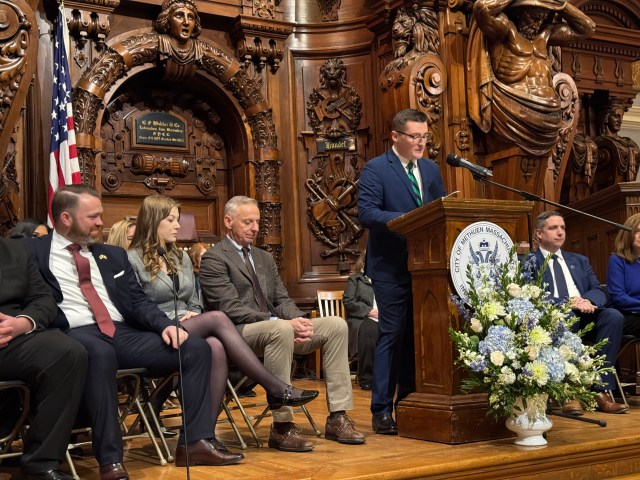
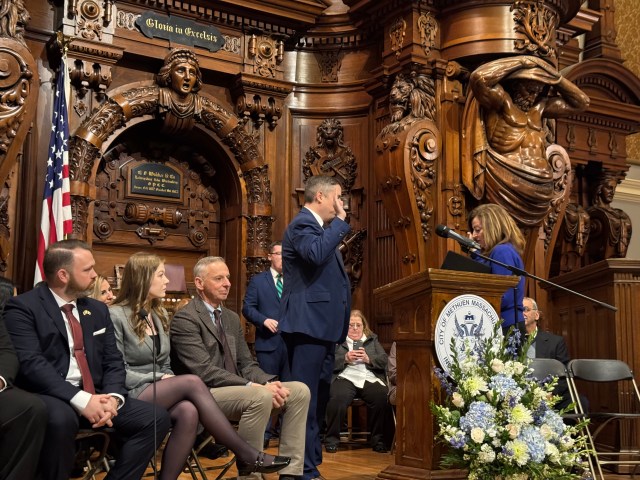
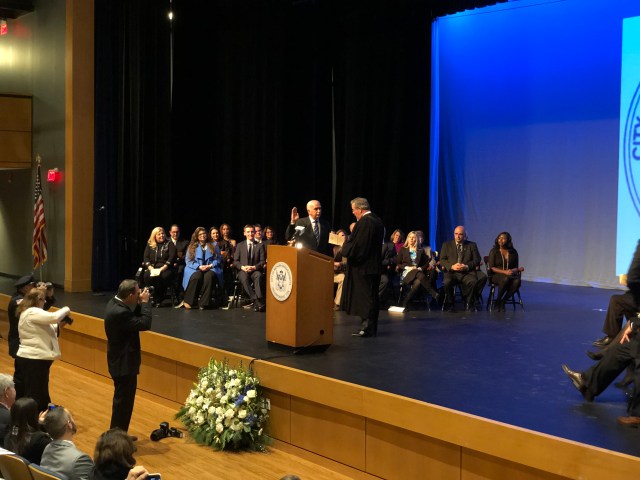
Methuen Mayor David (D.J.) Beauregard was inaugurated for his first full term of office on January 2, 2026. Mayor Beauregard had been selected, from the City Council ranks, to replace Mayor Neil Perry, who passed away before the expiration of his term. Mayor Beauregard defeated James Sarcione in order to fill the balance of Mayor Perry’s term, and with in the latest cycle defeated newcomer Barbara Stoebel to win a full term in his own right.
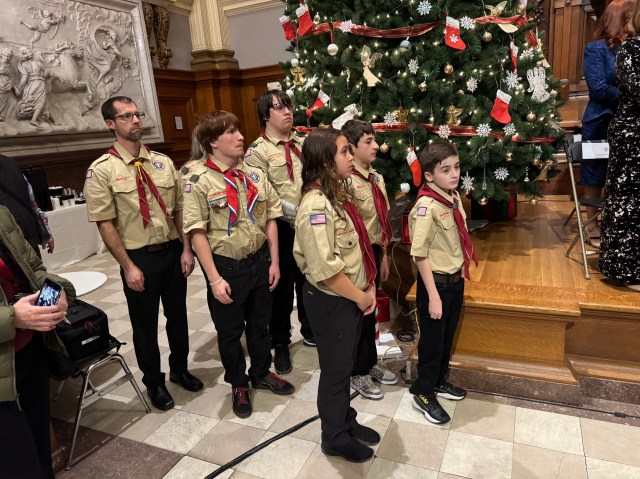
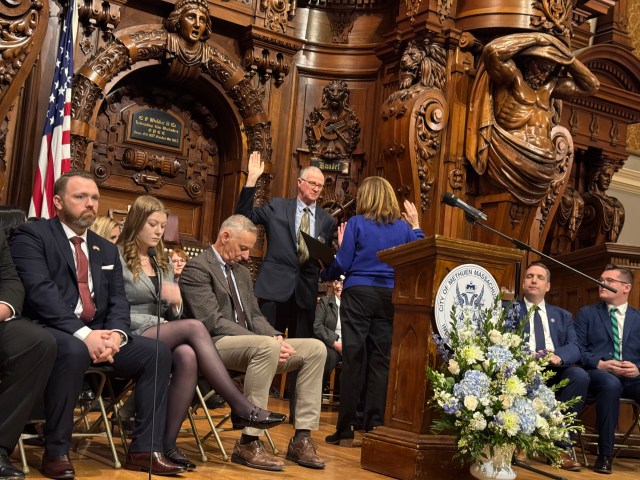
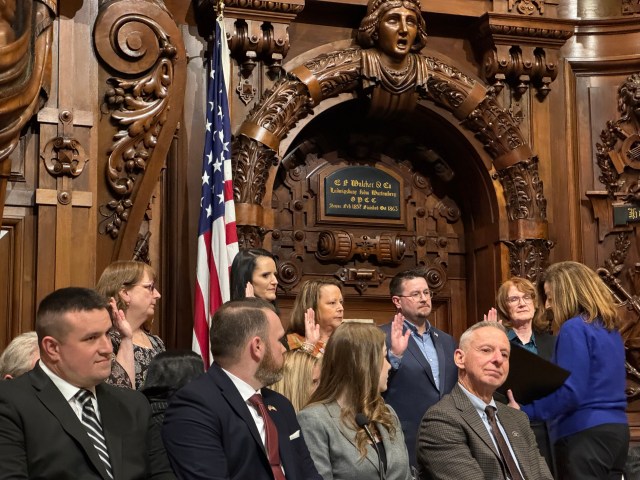
Mayor Beauregard was sworn in, with the newly elected City Council, School Committee, Greater Lawrence Regional Vocational School Committee, Nevins Library Trustees and the Methuen Housing Authority elected Commissioners. Congratulations to all of Methuen’s newly elected officials.
Mayor Beauregard is Methuen’s seventh Mayor of the modern era, following the Charter change that brought us the mayoral form of government in 1993. Methuen changed to a Town Administrator/Council form in 1973 and then a Town Manager/Council form after abandoning Town Meeting. After the 1993 change Methuen had its first mayoral election since Samuel Rushton won the office before 1920. Mayors, by Charter, are limited to three two year terms. Let us take a look at the inaugurals of the six Mayors that preceded Mayor Beauregard.
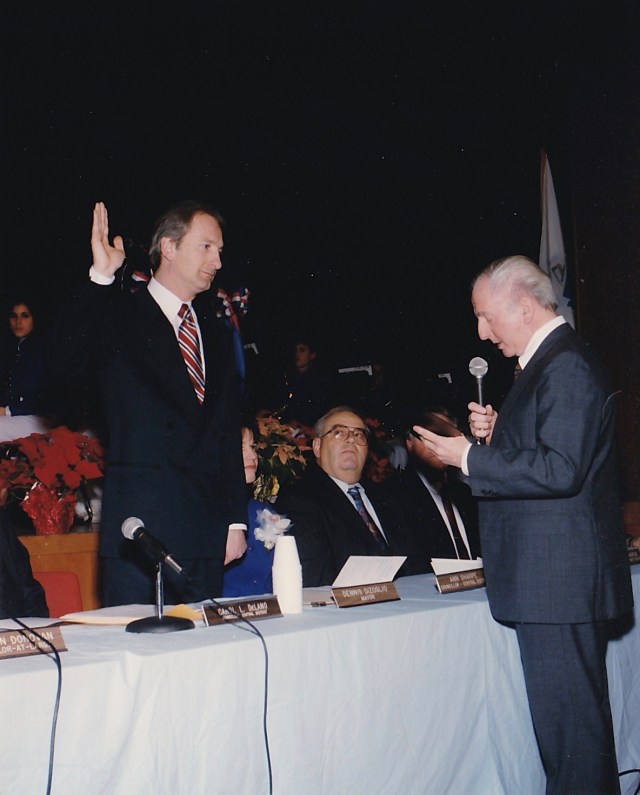
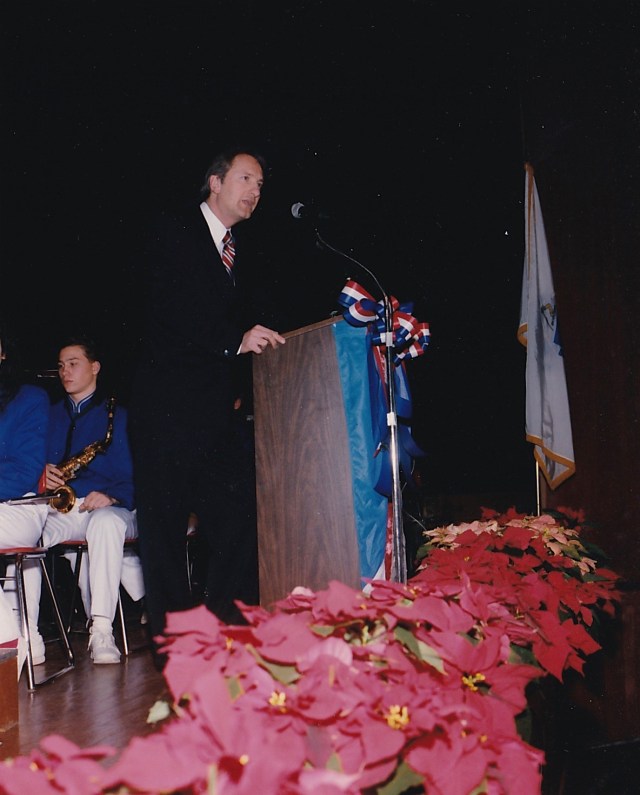
In 1994 Dennis DiZoglio led the ticket in the very large primary field, and then defeated a young upstart City Councilor named William Manzi in the final election to become Methuen’s first Mayor of the modern era. Mayor DiZoglio won three terms as Mayor, and during his tenure the school system built the three K-8 grammar schools (Marsh, Tenney, and the Timony schools.)
Mayor DiZoglio sworn in by Town Clerk James Maloney. Mayor DiZoglio gives his Inaugural address.
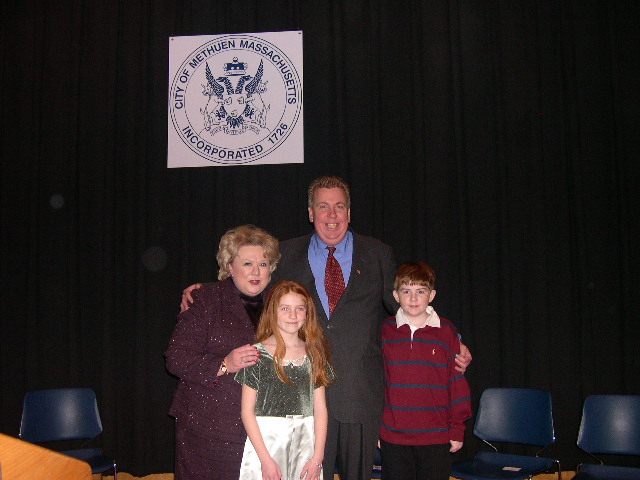
Mayor Sharon Pollard won the first of her three terms by defeating City Councilor Larry Giordano in her first run for that office. Mayor Pollard was a former State Senator, and a former Secretary of Energy for the Commonwealth of Massachusetts, working for Governor Dukakis. A little remembered fact is that then City Councilor Steve Zanni was in that preliminary election for Mayor.
Mayor Pollard posing with the Manzi family at her Inaugural
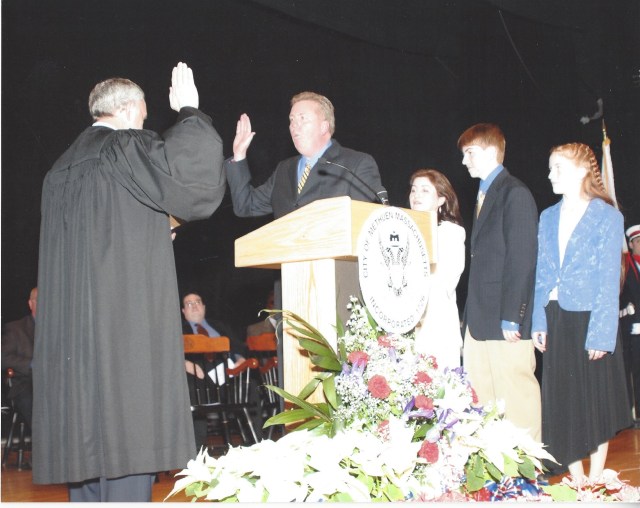
Following Mayor Pollard was Mayor William Manzi III. (Yes, the same one that lost to Mayor DiZoglio.) In my initial race I defeated Ellen Bahan for the office. In 2006 I was sworn in by none other than James P. Jajuga, outfitted in a regal set of Justice of the Peace robes. I also served three terms, and was very happy to secure the state financing for the High School project, and get that construction started.
Speaking to the crowd at the Tenney School in 2006.
Mayor Stephen Zanni was the fourth Mayor of the modern era. Mayor Zanni defeated Al Dinuccio in 2011, and twice won re-election. During his Administration the total renovation of Nicholson Stadium, including brand new artificial turf, occurred.
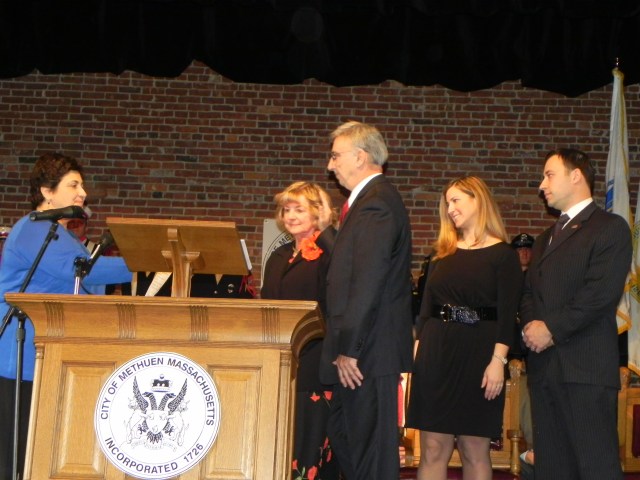
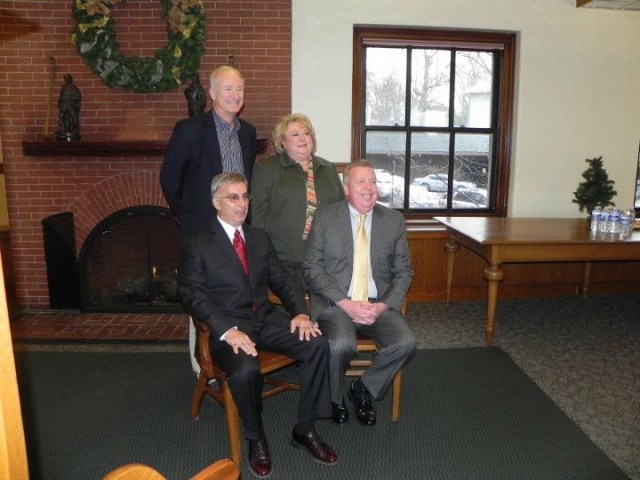
Mayor Zanni sworn in by City Clerk Tina Touma-Conway.The Four Mayors of the modern era pose at the Inaugural of Mayor Zanni in January of 2012.
James P. Jajuga was Methuen’s fifth Mayor of the modern era, and won election in 2017 while running unopposed. Mayor Jajuga is a former State Senator, has served as the Massachusetts Secretary of Public Safety, as well as having a long and distinguished career as a Massachusetts State Trooper. Mayor Jajuga served one term as the Mayor of Methuen.
Mayor Jajuga is Sworn in as Methuen’s Fifth Mayor of the Modern Era. The Five Mayors of the modern era pose at Mayor Jajuga’s Inaugural
Mayor Neil Perry was elected to his third terms in office and sworn in on January 3, 2024. Mayor Perry stabilized Methuen’s finances and guided the City through some of the very difficult aspects of COVID. State oversight of Methuen’s finances ended on his watch. Mayor Perry passed away while in office.
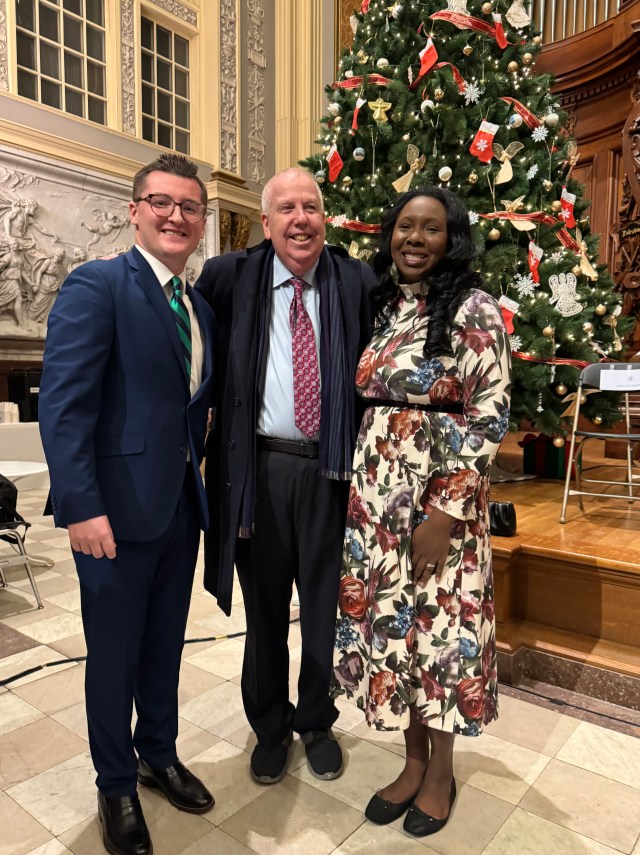
Mayor Perry Sworn InThree Mayors. Mayor Neil Perry with former Mayors William Manzi III and Dennis DiZoglio
Anderson has provided a very important history of the run-up to the fall of the Shah and the onset of the Iranian revolution, with a history of U.S. involvement in Iran going back to World War 2. If you are wondering how the United States made such a mess out of the relationship with Iran this is the book for you. For those without a lot of knowledge of this history you may be amazed at how many missteps, blunders, and general mistakes were made by the diplomats working for the U.S. on the “Iran desk” as the end of the regime came closer.
The American diplomatic incompetence on Iran was not just attributable to one or two powerful officials in a position to push an incorrect line, but was deeply ingrained in the entire bureaucracy, with small exception. An aversion to upsetting the prevailing group think, and a strong attachment to the Shah simply blinded key policy makers from some fairly discernible truths. Amazingly, when the Shah was teetering, and after he fell, there were some in the U.S. that painted Ayatollah Khomeini as a viable alternative, misreading the very plain signals that Khomeini had put out while in exile. We are still paying the price for this incompetence.
The Shah of Iran came to power after a U.S. supported coup in 1953 overthrew Iranian Prime Minister Mohammed Mosaddegh. This coup has been the source of much Iranian outrage over the years and decades, and a powerful source of anti-Shah propaganda while he was in power. The Shah started as a “tool of the Americans” in many Iranian minds and in the end that is where he ended up.
Anderson gives us all the history but really focuses on the run-up to the Shah losing power in Iran, and how both the Shah and the U.S. State Department just did not have a grip on the realities on the ground in Iran as the political upheaval began. Not all of the State Department personnel on the Iran desk were incompetent, but the major players were. The American failures went right up the line to the national security team in the White House headed by Zbigniew Brzezinski. The failures were not limited to the diplomatic corps. On the first page of the book Anderson gives us a CIA assessment of Iran’s political future.
“The Shah will be an active participant in Iranian life well into the 1980’s…There will be no radical change in Iranian political behavior in the near future.” -secret CIA report “Iran in the 1980’s,” August 1977, five months before the start of the revolution.”
Anderson, Scott King of Kings The Iranian Revolution: A Story of Hubris, Delusion and Catastrophic Miscalculation. Preface Page 1 The strength of the book lies, in my view, in the separate tracks Anderson gives us a clear eyed view of. The tracks are:
1. The governing activities of the Shah, and the delusion which propelled his actions, or lack thereof. 2. The diplomatic failures of the American government, which were both wide and deep. 3. The Khomeini revolution and how it managed to succeed, and how the Ayatollah managed to somewhat cloak his true intentions, and essentially jettison some of the initial “moderates” that provided him political support while he was in exile. Deeply connected to items 1 and 2.
Lets look at the diplomatic failures of the U.S. which were so pervasive that they can be fairly described as embarrassing. The type of failures involved here would, in my view, become symptomatic of future U.S. diplomatic disasters, like Iraq. Different players, same characteristics. The Administration sets a diplomatic marker and seeks to carry it forward regardless of facts on the ground, and treating anyone who had a different point of view as someone to be marginalized.
“Going all the way back to the 1940’s, the shah became incensed whenever he learned foreign diplomats were talking with those he considered his competitors or opposition. As U.S.-Iranian relations grew steadily closer, so did the desire of successive American ambassadors to stay on His Majesty’s good side, and the more they discouraged their underlings from consorting with malcontents or pursuing the sorts of critical fact-gathering forays known to upset him.
Anderson, Scott King of Kings The Iranian Revolution: A Story of Hubris, Delusion and Catastrophic Miscalculation. Page 85
The U.S. embassy had a lack of Farsi speakers, and as noted above a desire to put the best face on the delusional beliefs of the Shah. The U.S. embassy did not have enough Farsi speakers? One of those Farsi speakers, an American diplomat Michael Metrinko, reported on severe unrest in the countryside that did not comport with the line put forward by the Shah’s government. Metrinko’s analysis was given short shrift by the U.S. Ambassador, and relegated to a a diplomatic pouch that was not read in Washington. Gary Sick was another whose counsel was marginalized. The Carter Administration had, across the Board, severe divisions on foreign policy. In this case the top echelons essentially took their eye off the ball and relied on the representations of the Iran desk and the Embassy. That was a fatal mistake.
The Shah, for all his reputation as an autocrat, simply did not have the personal strength to deal with difficult issues, even those not related to his eventual overthrow. Brzezinski believed that the Shah should have suppressed the Khomeini revolution with the military. His indecisive nature had always been problematic, but when faced with the tidal wave of the Khomeini movement he just froze. American misjudgment as to what Khomeini represented contributed to the chaos, but the Shah, living in his own world, could not devise any workable solution. The American lack of understanding of the true nature of Khomeini was inexplicable. Khomeini had, as part of his ongoing propaganda effort, distributed throughout Iran fiery anti-Shah sermons on cassettes. These cassettes gave some clue as the the true goals of the Ayatollah, but they were never translated by the American side.
Khomeini’s usage, and eventual jettisoning of the moderate elements of the movement, is a fascinating look at how it was not just the U.S. government that was fooled by the Ayatollah. Prominent early supporters, even government ministers, eventually fell as the regime radicalized. Maybe if we translated a few cassettes the surprise would not have been as big.
If the American diplomatic effort was not so awful could the Shah’s regime have been saved? That is hard to say with any degree of certainty. The Shah himself may have been beyond saving due to his own high level of detachment. The Carter Administration has taken a lot of criticism over the years, and in this case much of it is deserved. The final indignity, of the U.S. embassy being overrun and American diplomats being held hostage, was precipitated by the total mishandling of the admission of the Shah to the United States by the Carter Administration. Carter himself, in initially refusing the Shah entry, understood the dangers of admittance. When the Shah’s medical condition, after leaving Iran, took a turn for the worse, President Carter, under significant pressure, was moving to reversing himself and allowing the Shah to enter the U.S. he asked his staff, some of whom were advocates for the Shah being allowed in:
“What are you guys going to advise me to do if they overrun our embassy and take our people hostage?”
Anderson, Scott King of Kings The Iranian Revolution: A Story of Hubris, Delusion and Catastrophic Miscalculation. Page 396
Despite that worry the Shah was admitted without any withdrawal of U.S. personnel from Iran. Another major mistake, and one that helped to doom the Carter re-election effort.
If you have any interest in how the Iranian revolution came to be, and how the U.S. managed to bungle the diplomacy involved, this book is outstanding and a must read.
If there was ever an overused historical example it is the Munich Agreement that led to the dismemberment of Czechoslovakia in 1938. This overuse has numbed people to the analogy and it is likely that the actual details of the agreement have been largely forgotten by most. So what actually happened at Munich? Why has it come to represent the worst of diplomatic results when dealing with an aggressor nation? Let us unpack what actually happened at Munich, and in so doing see if the “playbook” looks familiar.
Adolph Hitler did not begin his expansionist actions with Czechoslovakia. Hitler strove, from the beginning, to escape from the terms imposed by the Wold War I victors through the Treaty of Versailles. That treaty prohibited any political union between Germany and Austria. Hitler controlled the Austrian Nazi Party, and through that organization created enormous political chaos in Austria, including the assassination of the Austrian Prime Minister in 1934, (a failed Nazi coup) and through the diplomatic bullying that Hitler was a master of eventually absorbing Austria in 1938. This was not the first violation of Versailles undertaken by Hitler, and like the prior violations the western powers chose to ignore it and hope for the best. Hitler explained to the Austrian Prime Minister that no country would come to their aid, and said of France:
“France, he said, could have stopped Germany in the Rhineland ‘and then we would have had to retreat. But now it is too late for France.’”
Shirer, William The Rise and Fall of the Third Reich pg. 327
Hitler saw the writing on the wall for France. It was a prescient observation.
After the absorption of Austria Adolph Hitler began preparing the fate of Czechoslovakia. The nation of Czechoslovakia was a creation of the Treaty of Versailles, and always considered by Hitler, on that basis, to be illegitimate. Czechoslovakia had a disparate population, including a large German minority. A German political party, in the Sudetenland area of Czechoslovakia dominated by German speakers, quickly came under the control of Hitler, and like the Austrian Nazis, began making demands of the Czech government that could not be satisfied. Hitler’s political demands centered around the treatment, by the Czech government, of its German minority. Hitler’s true intent was the military liquidation of Czechoslovakia and its absorption into the German Reich. His plans for this included the preparation of Case Green, the military codename for a German attack on Czechoslovakia. The fig leaf of mistreatment of the German minority was never the real issue. Hitler, before provoking the Czech crisis, had prepared the German military for a lightning strike on Czechoslovakia. In meeting with the German Sudeten leader Konrad Heinlein Hitler gave specific instructions:
“Hitler’s instructions, as revealed in a Foreign Office memorandum, were that ‘demands should be made by the Sudeten German Party which are unacceptable to the Czech government.’”
“As Heinlein himself summarized the Fuehrer’s views, ‘We must always demand so much that we can never be satisfied.’”
Shirer, William The Rise and Fall of the Third Reich pg. 359
The Czech state had security commitments from France and the Soviet Union that should have rendered military assistance in the event of aggression against it. The British had warned Hitler that if France honored that commitment the British would support the French militarily. The Czechs had a very formidable military and a very extensive set of fortifications that would have to be breached by the Germans in the event of a military confrontation while the French and Soviets would be supporting the Czechs. From a military perspective the Germans would have had a heavy lift if the mutual security agreements had been honored. So what happened?
The continuing pressure of Hitler on both the Czechs, and by extension the French and British, managed to pry the Czech allies away. It is easy today to condemn British Prime Minister Neville Chamberlain for his actions, but Chamberlain believed that Hitler had a legitimate grievance and that a world war over the Sudetenland was not worth the cost. He also believed the “assurances” received from Hitler on this matter. (Hitler told Chamberlain, and the world, that this was his last territorial demand in Europe.) Chamberlain was in error on both counts but that was not so clear at the time. The Hitler “playbook” on these matters was not fully understood. Munich has become the focal point of this story, but in fact the “Czech crisis” drummed up by Hitler brought Chamberlain to Germany three times to meet with Hitler. (September 15, September 22, and finally at Munich September 29)Hitler’s core demand was that the Sudetenland portion of Czechoslovakia be ceded to Germany and militarily occupied by the German army. In the run-up to Munich the Czech government had refused to accede to this German demand, realizing that to do so would place what was left of their country under direct military threat from Germany, as the military fortifications referenced above fell within the area to be ceded. When the Czech government finally gave way on the dismemberment of their country it was because the French and British abandoned Czechoslovakia to its fate. Hitler had managed to split the alliance, and neuter the security guarantees given to the Czech government by France. In so doing the British and the French managed to place responsibility for whether war broke out on the victim state. In a September 27 note to Czech President Benes Chamberlain wrote:
“…Chamberlain could not refrain from admonishing them, in the last part of his message, ‘that Bohemia would be overrun by the German Army and nothing which another Power or Powers could do would be able to save your country and your people from such a fate. This remains true whatever the result of a world war might be.’ Thus Chamberlain was putting the responsibility for peace or war no longer on Hitler but on Benes.”
Shirer, William The Rise and Fall of the Third Reich pg. 402
Blaming the victim of aggression, rather than the aggressor.
Hitler, in his diplomatic maneuvering against the Czech state, had pressured the Hungarians and the Poles to make their own territorial demands against the Czechs, which they did. Germany was the main driver, but not the sole actor, in this tragedy. It would turn out to be a most unfortunate decision by Poland.
Hitler’s real thoughts on the Czech state were not hidden. In a speech on September 26 that was described by William Shirer as the first time he had ever seen Hitler totally lose control of himself Hitler said this about the nation of Czechoslovakia: (Speaking of Benes at the Treaty of Versailles negotiation)
“He made his great appearance in Versailles, claiming that there was such a thing as a Czechoslovakian nation. He resorted to this lie to make his own people sound, despite their meager numbers, more important and to lend credence to its demand for greater influence. At the time, the Anglo-Saxon powers, renowned for their great lack of knowledge in geographic and volkisch matters, did not deem it necessary to investigate Beneš’ claim. Otherwise they most certainly would have realized that there is no such thing as a Czechoslovakian nation.All there is are Czechs and Slovaks and the Slovaks have little desire of being with the Czechs, rather . . . In the end, thanks to the efforts of Herr Beneš, the Czechs annexed Slovakia. Since this state did not appear to be a viable structure, they simply took three and a half million Germans in clear defiance of the rights and desires of the Germans for self-determination. Since that evidently did not suffice, the Czechs took another million of Magyars, adding a number of Carpatho-Russians and several hundreds of thousands of Poles.
That is the state that would later call itself Czechoslovakia. It exists contrary to the clear desire and will of the nations thus raped and in clear defiance of their right to self-determination. As I speak to you today, I naturally have pity on the fate of these oppressed peoples. I am touched by the fate of these Slovaks, Poles, Hungarians, and Ukrainians. Yet I can only be the voice of the fate of my Germans.”
Hitler Speech Sportpalast September 26, 1938
We see the denial of Czechoslovakia as a legitimate state. We see the blaming of the victim of aggression for the aggression, with the rationale being that the Czechs would not stand a chance against the German army. And we see that the British and French undertook to “guarantee” the remaining borders of rump Czechoslovakia through the Munich Agreement. So after making territorial concessions demanded by its putative allies rump Czechoslovakia was now going to rely on those same allies to “guarantee” what was left of the Czech state. Hitler, with the Munich Agreement still drying, had other plans.
Hitler, using the by now familiar tactics of diplomatic bullying and blackmail, induced the Slovaks to declare independence from rump Czechoslovakia, further sealing the fate of the Czech nation. This was of course accompanied by the newly “independent” Slovakia sending Hitler a telegram requesting that Germany “take over the protection of the new state.” (Both the declaration of independence and the telegram were written by the Germans.) With rump Czechoslovakia further reduced Adolph Hitler summoned the President of what was left of the Czech State and brow-beat the hapless Dr. Emil Hacha into submission. On March 15, 1939 in the early morning hour Dr. Hacha signed a statement, while in Germany, asking for the protection of Germany for what was left of the Czech state, which Hitler was more than happy to provide. The Germans occupied Prague as part of their final destruction of the rump Czech state on the same day. What about the British and French “security guarantees” to rump Czechoslovakia?
After the occupation of Prague Chamberlain took the position that the Slovak declaration of independence from the Czech state had nullified that guarantee.
“ ‘The effect of this declaration’ he explained, ‘put an end by internal disruption to the State whose frontier we had proposed to guarantee. His Majesty’s Government cannot accordingly hold themselves any longer bound by this obligation.’ “
Shirer, William The Rise and Fall of the Third Reich pg. 451
That position of the Prime Minister came under vehement attack in Great Britain, where Hitler’s duplicity was now evident for all but the willfully blind to see. After some thought Chamberlain came to see the Hitler maneuver for what it was and he issued a new statement.
“Is this the end of an old adventure or is it the beginning of a new? Is this the last attack upon a small State, or is it to be followed by others? Is this, in effect, a step in the direction of an attempt to dominate the world by force?”
Shirer, William The Rise and Fall of the Third Reich pg. 454
The Prime Minister, his eyes now fully opened, would give the British guarantee on Poland sixteen days after the German occupation of Prague.
As stated above the “Munich analogy” has been vastly overused. But that should not stop us from recognizing the playbook used so effectively, and to such destructive effect, by Adolph Hitler. You do not have to “be Hitler” to utilize the same diplomatic tactics he used, and we should understand why the Europeans are so aware of that playbook, and why some now choose to try to rewrite the history of German aggression in the run-up to the start of World War 2. The details matter. Attempts by pseudo historians like Darryl Cooper to rewrite that history by portraying Churchill as the villain of World War 2 are simply attempts to erase the details that matter, and make comparisons to those using that playbook today harder to make. The essential elements of the Hitlerite diplomatic thrusts are fairly visible to all.
Deny the historical legitimacy of the victim nation, as Hitler did to the Czechs.
Use the presence of a minority that speaks the language of the aggressor state to make claims of repression, and whip up national outrage over the mistreatment.
Seize land, either by military force or by having it ceded, (or both) and then dictate the terms of the survival of the rump state, and wait for further opportunity to finish the initial job. (Limitations on the rump state military are a favorite term)
The overuse of Hitler and Munich should not prevent us from seeing aggressor nations for what they are. The idea that aggressors simply wish to rectify a historical wrong and will be satisfied digesting only one nation inevitably leads to further carnage. German generals, in testimony at Nuremberg, said that the military position of Germany, in 1938, was simply not strong enough to win a two front war with Czechoslovakia and France.
Field Marshall von Manstein, at Nuremberg, said:
“If a war had broken out, neither our western border nor our Polish frontier could have been effectively defended by us, and there is no doubt whatsoever that had Czechoslovakia defended herself, we would have been held up by her fortifications, for we did not have the means to break through.”
Shirer, William The Rise and Fall of the Third Reich pg. 424
The West miscalculated, and everybody paid a horrible price. Standing up collectively to the aggressor in Czechoslovakia might have spared the world untold horrors. Hitler had not, in fact, made his last territorial demand in Europe. After giving such assurances he was, six months after the occupation of Prague, knocking on Poland’s door. Allowing land disputes to be settled by military action is a sure fire way to ensure that aggression will continue. History, in this area, has taught us some hard lessons. I hope we remember them.
The third book in what I would characterize as the “Abundance” trilogy. Author Yoni Appelbaum unlike the other two (“Abundance” by Ezra Klein, and “Why Nothing Works” by Marc Dunkelman) concentrates solely on the massive shortage of housing in the United States. The other two books did deal with the housing issues facing the country, and it is fair to say that the general conclusions of all three books are roughly the same. The housing market is so expensive, and so out of reach for so many, due to the rules and regulations (zoning) that we have imposed on the housing market. The author does point out, as with the others, that restrictive zoning that constricts housing supply, is especially prevalent in blue areas of the country. Progressives want housing, especially for those with affordability issues, but in practice enact regulation that provides the opposite result.
All three take some heavy aim at the California law CEQA, which, in the name of environmental protection, has created enormous roadblocks to housing development, and a host of other, non housing building (like high speed rail.) The focus on CEQA in these books has caught the attention of Democratic Governor Gavin Newsom, who has been pilloried on a podcast or two over the difficulty in creating housing in California. The Governor heard the message, and as part of the California 2025-2026 budget signed into law amendments to CEQA that would have, in the recent past, been unthinkable. The Newsom press release on the “groundbreaking reforms” contained the subtitle “Advancing an abundance agenda.” These books have, without question, stirred some heavy debate.
There are some obviously outrageous abuses of process highlighted in the book that support the author’s main argument. In Berkeley California the author reviews some arguments over additional student housing at the University. These arguments, in a progressive community, center on the opposition of some Berkeley residents to additional student housing.
“A few blocks farther down Piedmont Avenue sits the home of Phil Bokovoy. …he arrived in 1983, as a graduate student in economics, and bought a home six years later. …Bokoovoy is worried that too many people are now trying to crowd into the city with which he fell in love. In 2018 Bokoovoy sued the University through a non-profit he’s created, Save Berkeley’s Neighborhoods, , alleging that its decision to increase enrollment required an assessment of its environmental impact under the California Environmental Quality Act (CEQA) that it had failed to perform. The case made national headlines in 2022, when appellate courts affirmed a ruling by a California judge that adding more students could produce an adverse change to the environment.”
Applelbaum, Yoni, Stuck: How the Privileged and the Propertied Broke the Engine of American Opportunity. Pg. 111
So Mr. Bokovoy, having moved to Berkeley to attend University himself and staying to make it his home, has now determined that any additional influx of students would constitute an “environmental issue” under California law. A separate lawsuit over the same issue alleged a CEQA violation over the additional “noise” that would be generated by increasing the student body. That claim was initially ruled upon favorably by a California judge, forcing the California Legislature to amend CEQA so that “noise generated by people is not subject to CEQA review.” It is no wonder that CEQA has come under such scrutiny.
The author takes us through the history of how zoning came into existence in the United States, and that story is not a pretty one. The motivations of the original legal theorists who promoted zoning are shown to be borne out of racism. The aversion to “apartments” or multi-family housing, are not a recent thing. The Supreme Court, in an early legal test for zoning, said:
“When erected in neighborhoods of single family homes…’very often the apartment house is a mere parasite’, cashing in on the elevated value produced by its environs even as it erodes it, and therefore apartments come ‘very near to being nuisances.’ “
Applelbaum, Yoni, Stuck: How the Privileged and the Propertied Broke the Engine of American Opportunity. Pg. 162
Apartment buildings described as nuisances or parasites. The attitude has not changed much in the last 75 years.
All three books point to the progressive change in values that occurred after the enthusiasm for governmental action embodied by the New Deal. FDR’s determination to use the levers of government to blunt the impacts of the Great Depression eventually gave way to a deep cynicism about government from progressives. All the books point an accusatory finger at Robert Moses, and this author (and the others as well) points to all of the upheavals in the 1960’s as creating a desire within the Progressive movement to stop government from being able to act. This desire was borne out of some of the social disruption that created such a massive distrust of government in this period. All three books point to the long ago written Port Huron statement, issued in 1962 by the Students for a Democratic Society, as being a harbinger of this change. The Progressive movement was converted to thinking about the best ways to limit the ability of government to act. In many ways they have been successful.
The obstacles created for building sufficient housing supply to meet the demand, through zoning, as mentioned, are heavily covered. The author also shows us how the new housing realities have stopped mobility.
“The problem isn’t that we’re sorting ourselves out; it’s that we’ve ceased to mix ourselves together. Zoning has made our neighborhoods far less economically diverse, reducing the odds we will come into sustained contact with people of different backgrounds or with those who hold different perspectives. And regulations have separated areas with rental housing from areas with single family homes. When one in five Americans moved each year, neighborhoods were regularly infused with new arrivals, often bearing the views they’d adopted in their previous communities. Now, with only one in twelve Americans moving, that happens much less often. A more sedentary community will homogenize itself over time as social forces press longtime residents toward conformity and the flow of new neighbors bearing novel ideas and customs and beliefs slows to a trickle. The result is deepening polarization.”
Applelbaum, Yoni, Stuck: How the Privileged and the Propertied Broke the Engine of American Opportunity. Pg. 17
The author buttresses this point with a statistic that is eye opening. Speaking of the 2016 election:
“A month before the election, we found that among white voters who had moved more than two hours from their hometown, Hillary Clinton enjoyed a solid six point lead. Those living within a two-hour drive, though, backed Trump by nine points. And those who had never left their hometown supported him by a remarkable twenty-six points.”
Applelbaum, Yoni, Stuck: How the Privileged and the Propertied Broke the Engine of American Opportunity. Pg. 15
One last stat that is pretty damning for those on the progressive side of the aisle.
“A study of California found that as the share of liberal votes in a city increased by ten points, the housing permits it issued declined by 30 percent.”
Applelbaum, Yoni, Stuck: How the Privileged and the Propertied Broke the Engine of American Opportunity. Pg. 16
There is a lot to digest in this book, and in my view the author correctly highlights some of the obstacles, and yes hypocrisy, to getting our housing market right sized. Those obstacles are unfortunately created mostly at the local level, through restrictive zoning. But it must be pointed out that attempts to change zoning to accommodate new housing units, especially rental units, are usually met with the fiercest of resistance. Democracy does not always produce optimum results. It is hard to imagine a local official standing up and telling a majority of his constituents that they are wrong and voting to place housing in the teeth of determined political opposition. Massachusetts has 40B, and now the MBTA Communities Act, but local opposition has been fierce in many communities. Even Gavin Newsom, cited above for actually getting CEQA modified to address the obstacles created for housing, has taken a step back in Los Angeles. (This was written over several days, so Newsom, in response to severe pressure, waived the reform in a specific case.) As mentioned these decisions are not easy ones.
This book, like the other two, comes highly recommended and is contributing to a much needed debate on housing in the United States.
The review of the 2024 Water and Sewer accounts is complete and has been submitted to the Seabrook Board of Selectmen. These two reports are significant for the results shown through effective Board action to eliminate the deficits in both accounts and move both to true enterprise status. The changes made in late 2023 did not include formally separating the budgets. That change was implemented in 2025.
A fairly timely book as well as a very important one as trade and U.S. manufacturing come front and center with the Trump Administration making major changes to U.S. tariff policies. This effort comes from Patrick McGee, an Apple coverage veteran.
The book is important, in my view, because it brings a much fuller understanding of several key issues that frankly have not been well understood in the United States, though they are very well understood in China. Can the United States, simply by imposing tariffs, shift Apple manufacturing back to the United States? What is the nature of the Chinese manufacturing edge, beyond labor costs? How did Apple become so reliant on Chinese manufacturing and is it now possible for them to simply shift manufacturing back to the U.S.?
The author gives us a short history of Apple, including the exile and return of Steve Jobs, and how the old Apple actually manufactured what they sold themselves. Jobs initially believed this to be a necessity, as Apple created products that were not simply utilitarian but designed in a way to make them stand out. Apple’s designs did indeed create “beautiful” products, with that beauty creating significant engineering challenges. Jony Ive did in fact create magnificent designs, and Jobs fought hard with his own engineers to ensure that these designs became real Apple products. Within that Jobs fixation lay the seeds of the ultimate move of manufacturing to China. Jobs believed that this complexity forced Apple to manufacture its own products, and they actually owned factories in the U.S. The author shows us how the turn came, and how big of a turn in was.
The slow turn came after Apple dipped its toes in the contract manufacturing water in Japan and Taiwan and recognized that there were both cost savings and the expertise to build ever more complex products. How did contract manufacturers in Taiwan and China become able to handle the complexity of Apple products? The author shows us that the main way they learned was from Apple itself. Apple had selected Quanta of Taiwan as a back-up manufacturer of Powerbooks:
“At first the quality and capabilities Apple found were subpar. ‘Treachery, ineptitude, sloppy, negligence on every level,’ are the words used by one senior engineer to describe Taiwan at the time. ‘Quanta was not a very good development partner whatsoever,’ says another. ‘The talent to take on manufacturing, part fabrication, assembly, design challenges-the talent to do that with Quanta in Taiwan was not there.’ The role of Apple engineers was to change all that through extensive training. This strategy soon proved to have a profound impact on the country and its neighbors, where Apple sourced many of the components. Apple wasn’t, by any stretch, the largest computer maker working in Taiwan, but its penchant for complex designs and intolerance for defects was unique and over-the-top, necessitating a form of intellectual investment shared by none of its rivals. Apple veterans from the time can’t stress enough that nobody else was embedding dozens of engineers into Taiwanese suppliers, then consistently pushing the envelope on what was possible. ‘Apple is single-handedly responsible for bringing quality into Southeast Asia,’ says Robert Brunner, the director of the ID studio from 1990 to 1997.”
Apple in China: The Capture of the World’s Greatest Company McGee, Patrick pg. 77 You take that excerpt and simply magnify it by a very large factor, and that is what happened in China. As Apple had success, that success required a significant increase in manufacturing capacity, which required more manpower. In China, at the time, there was no limit to manpower, or any concern about working conditions. The inexorable move to contract manufacturing, and of contract manufacturing to China, began. Andy Grove, of Intel, had a prescient observation:
“The cofounder of Intel, Andy Grove, would later diagnose the problem as ‘a general undervaluing of manufacturing-the idea that as long as ‘knowledge work’ stays in the US, it doesn’t matter what happens to factory jobs.’ But as Grove warned: ‘our pursuit of our individual businesses, which often involves transferring manufacturing and a great deal of engineering out of the country, has hindered our ability to bring innovations to scale at home. Without scaling, we don’t just lose jobs-we lose our hold on new technologies. Losing our ability to scale will ultimately damage our capacity to innovate.’”
Apple in China: The Capture of the World’s Greatest Company McGee, Patrick pg. 112
Grove, in my view, had it exactly right. As the move to China accelerated for Apple, and the company began to grow by leaps and bounds, nobody in Washington was giving much thought to what was happening. As more manufacturing moved to China the satellite operations for manufacturing, especially Apple style manufacturing, moved right with the contract manufacturers. Industrial clusters sprang up, with major investments made by the Chinese government at all levels to make such clusters economically attractive to the arriving companies.
“Twenty six years later, the closed architecture of the iPhone was driving a different trend: the Chinafication of the electronics industry. The more Apple scaled, the more economic sense it made for all the components inside its products to be made within the country. …’It’s not really a global supply chain. In principle it is; but in practice it’s this totally engineered stack of process and product, engineering and production, and its all synced up in one place.’”
Apple in China: The Capture of the World’s Greatest Company McGee, Patrick pg. 176
Some of the biggest contract manufacturers in the world are now based in China, with Apple, as shown above, bringing in vast engineering resources to show these firms how to do complex manufacturing. But it was not just engineering talent that Apple brought. When Apple appeared to finally have some real difficulties with the Chinese government as a consequence of the new priorities brought by President Xi upon his assumption of power in China, after a period of not quite understanding, brought to the table a commitment of a $275 billion investment in China.
“Cook’s goal was to convey a similar message, to demonstrate to Chinese officials that Apple’s success in China had ripple effects across the advanced electronics industry. By investing in and teaching local suppliers, Apple was inculcating a corpus of hands-on-knowledge, both in tangible skills and abstract concepts, which applied well beyond serving its own needs. True, this was unintentional; Apple hadn’t designed its supply chain to spur innovation at its suppliers. Yet that is exactly what its had accomplished. And Apple’s investments weren’t just large, they were ruthlessly efficient and narrowly targeted in the advanced electronics sector-‘by far the most important’ thing desired by Xi, according to China Scholar Barry Naughton. Conveyed in the right language, this impact was wildly supportive of Beijing’s goals to learn from the West and move up the value chain.”
Apple in China: The Capture of the World’s Greatest Company McGee, Patrick pg. 281-282
The author compares the $275 billion to the joint private investment in Mexico by the U.S. and Canada after NAFTA, which the Apple investment in China exceeded. Key knowledge transfer, massive financial investment in manufacturing, and political pliancy have placed Apple in a prime position in China, but with the potential for some level of decoupling between China and the United States is that positioning going to be good for Apple? Is there anyway for them to shift manufacturing out of China?
This book brings us some real insight into how China became such a manufacturing behemoth, and how deep the connection is now between the Apple business model and China. It should dissuade those who may believe that manufacturing can simply be “moved” from China to the U.S. by building a few factories in the U.S. Past American policymakers have not fully grasped the full implications of the offshoring to China. Andy Grove understood the implication and now we must figure out the best way forward as the U.S. looks to reestablish domestic manufacturing. This book is highly recommended.
A bit of an older one but a very good read anyway. Rodman, who has passed away, was an assistant to Henry Kissinger in the Nixon Administration, who wrote the foreword. I saw a positive reference to this in the last HR McMaster book and it looked worthwhile.
Rodman worked in several Republican administrations after Nixon, in the State Department, the National Security Council, and the Defense Department. This book looks at the foreign policy decisions of Presidents from Nixon through George W. Bush with an emphasis on how those decisions got made and what type of infrastructure each President set up to handle the process. This is where the strength of the book is, and though it was written more than a few years ago the recent decision of President Trump to dramatically downsize the staff at the National Security Council makes this book topical today.
Rodman is an advocate of strong Presidential power, but as he acknowledges in the opening this book centers on the exercise of that power within the executive branch itself, not vis a vis Congress or the courts. In light of the preference of President Trump for near total control of the executive branch this book, by looking at some of the past Presidents and their use of executive power, is relevant to events happening now.
I believe, likely a bit more than some others in the Democratic Party, that the President should be able to, for better or worse, exercise the authority of the office. The book started with a President Lincoln story that is both funny and on point:
“There is a famous story of President Abraham Lincoln, taking a vote in a cabinet meeting on whether to sign the Emancipation Proclamation. All his cabinet secretaries vote nay, whereupon Lincoln raises his right hand and declares ‘The ayes have it.’ “
Rodman, Peter Presidential Command pg. 3
Rodman gets us started with Nixon and Kissinger, looking beyond the policies to see what Nixon wanted, and how he pulled the levers of power within the Administration. It is a many times told story of Nixon, and Kissinger, undercutting and marginalizing Secretary of State William Rodgers. Rogers, despite being a very old and close associate of Nixon, was shut out because Nixon was determined to go around the career staff at the State Department, who he distrusted (and hated) This baseline is used throughout the book, as Presidents are shown to use differing methodologies to try to bring the bureaucracy to heel. Rodman quotes McGeorge Bundy on that ever present battle:
“The unending between the Presidency and much of the bureaucracy is as real today as ever, and there has been no significant weakening in the network of triangular alliances which unite all sorts of interest groups with their agents in the Congress and their agents in the Executive Branch…. [T]he Executive Branch remains woefully short of first-class executive agents of the President….The Cabinet role which I am trying to describe….in its relation to the White House….must be at once highly autonomous and deeply responsive. It is political, but only in the Presidents interest. It is managerial, but only on the President’s terms….At a test-unless he means to resign-the Secretary should always be the President’s agent in dealing with the bureaucracy, not the other way around.”
Rodman, Peter Presidential Command pg. 11
This tug of war is a central feature in the book. As Rodman looks at the Presidents from Nixon to Bush 43 a critical distinction in evaluating key personnel, like a Secretary of State, gets back to the Bundy points above. Will a person posted to the State Department become “captured” by them or will he or she be willing to buck the bureaucracy and continue to represent the President.
In this context Rodman goes through the covered Presidencies, highlighting strengths and weaknesses of the decision making, and of the process by which decisions got made. Rodman worked for Republican Presidents, and I detect a slight bent towards the GOP Presidents, but nothing that makes his observations unfair.
I had some level of disagreement with the Rodman observations on Bush 43 and Iraq. Rodman worked for Doug Feith in that administration, and on that basis alone I went from five stars to four. I share General Tommy Frank’s assessment of Feith, and I believe that Rodman, while acknowledging error, did not emphasize that error enough. (He failed to mention the Franks assessment of Feith) He manages to repeat some of the flat out nonsense that propelled the U.S. into the war, and even gives a mulligan to Don Rumsfeld on the “size of force” question for the U.S. invasion. It was Rumsfeld who demanded that we go in light, with the generals giving way to their boss.
Despite the Iraq portion there is still some great observations on how Bush 43 conducted policy and dealt with some of the large personalities in his Administration.
Each President covered brings us great insights into how power is spread, and used, in the executive branch, with each President’s differing approaches critiqued. For folks interested in national security, and with some of the past giants involved in that field, this book comes highly recommended.
The Town of Seabrook is pleased to announce a new three year tax agreement with NextEra, the owner of the Seabrook Station nuclear facility. This agreement will cover FY 2024, 2025 and 2026 and is for $45 million. This is an increase of $5 million over the prior three year tax agreement that covered 2021, 2022, and 2023, and a $9 million increase over the tax agreement covering 2018, 2019, and 2020. The Town is grateful for the efforts of all of the parties to the agreement.
Seabrook held its Memorial Service and parade yesterday, remembering and honoring those veterans that made the ultimate sacrifice in defense of freedom. Thank you to the Seabrook Board of Selectmen for their strong support, and to the American Legion Raymond E. Walton Post 70 for all of their hard work. Thank you to Recreation Director Cassandra Carter, the event organizer who did such an outstanding job. Our thanks to the Seabrook DPW, who made the grounds look impeccable. Many thanks to the Seabrook Fire Department for their participation, and to our Police Department for all of their work. It was an honor to have Gold Star Mother Florence Souther present for the service.
Former British Prime Minister, and now man of the world, through the Blair Institute, Tony Blair, has written a book on leadership that is well worth the read, even if you are not planning on being a Prime Minister or President. The concepts discussed are applicable across the political management spectrum.
Blair’s record of achievement as Prime Minister, both substantively and politically, is really astounding. He is the second longest serving Prime Minister (behind Margaret Thatcher) in the post war period, the longest serving Labor Prime Minister, and the only Labor leader to ever lead Labor to three consecutive general election victories. His concept of “New Labor” changed the image of the Labor Party to one that could govern, and would not be held captive by the more ideologically rigid element of the Labor Party. He moved the Party to the center.
The book is not a memoir (he wrote that already) but a primer, from Blair’s perspective, on how to be a leader. His experiences as Prime Minister, and as opposition leader, have brought him some valuable perspectives on how to be effective as a leader. His insights are valuable even if your goal is not to be the Prime Minister of Great Britain. What does it take to lead effectively? Blair gives us his roadmap.
Some of the items Blair outlines might seem to be self evident. But when you ask a political leader (Managers, Mayors, Governors) whether they have in fact covered that base I would venture to say that many would say no. The first item Blair touches on is “having a plan.” (Be the leader with a Plan.) He cites the comment by American diplomat George Kennan “If you don’t know where you are going any road will take you there.”
“A ‘plan’ is a route map for governing. It sets out the destination, the milestones, and, above all, the priorities. It forms the ‘why’ and not simply the ‘what’ or the ‘how’. It focuses the mind of government; indeed in a certain sense it creates the mind of government. The preparation that goes into drawing it up is intense. Bad plan:bad government.”
Blair, Tony On Leadership: Lessons for the 21st Century pg. 2
Blair goes further on the “focusing the mind of government.” The plan will give the “ministers” a clear direction of where the leader wants to go, the priorities set, and an agenda to follow. Blair does not see the need to belabor the fact that it is the LEADER who sets the agenda and drives the government towards fulfilling the goals associated with the leader’s agenda. A leader without a plan, or an inability to drive an agenda, is wasting time.
Blair tells a story about Bill Clinton imparting to him what Clinton considered to be a valuable insight, which was “keep control of your schedule.” It was before Blair took office as P.M. and he tells us that he was a “bit underwhelmed” with this advice. But after he took office he realized how correct Clinton was. Clinton was not urging “downtime” or golf but rather some time to read, reflect, and set new action plans to further drive the leader’s agenda. Clinton was correct, and Blair came to see that.
Blair truly gives us some great thoughts, including the title of Chapter Three. “Prioritization Try to do everything and you will likely do nothing.” It says it all but it really needs to be driven home. Blair’s comment, that “government operates by bandwidth” is right on the money. No bandwidth, no results. Blair gives us some great advice, and some real world examples, including how Brexit simply consumed enormous amounts of ministerial bandwidth in Britain, knocking other important issues off the plate.
Amongst all of the great observations Blair gives us possibly the most important one comes in Chapter 4. He leaves himself a bit of wiggle room in titling that chapter by saying that “Good policy is (nearly) always good politics.” I could not agree more. Good results, even over time, make for good politics. Inside that Chapter he hits on something that I believe has been a bit lost at all levels of government in this country, and that is that the leader should know his brief.
“At one level politics is a crude retail business: winning votes, devising slogans, kissing babies, and having the physical stamina to survive a brutal campaign. But at another level -the dimension called government-it is an intensely intellectual exercise. It requires real brainpower. And study. Politicians become adept over time at speaking about things they haven’t a clue about. And, if they’re good at it, they can do it with panache and-to the uniformed ear-credibility. In the real world of government that doesn’t cut it. You should know what you are talking about because you have taken the time and effort to master it.”
Blair, Tony On Leadership: Lessons for the 21st Century pg. 26
What a concept. The leader should know what they are talking about. What does that mean? How can you tell? Talk to a leader. See if they are conversant on budgets, education, or any issue you are concerned with. See if they understand how an budget action in one area might impact a subject in another area. If a leader does not know or understand the brief then what you get is staff setting the agenda, and staff setting the priorities. Hard to lead on a subject when you do not know the brief.
Blair is rightly proud of having created a “Delivery Unit” at Downing Street to take items that had been agreed, and get them to implementation. You might ask why a universally accepted idea needs a special focus on implementation? If you are asking that question you likely have not worked in government. Just coming up with an idea, announcing it, and moving on to the next idea, will not cut it. With short attention spans it might even work for a bit but if you are serious about leading you will want to ensure that implementation is part of the program. Blair calls it “le suivi,” the French term for “follow-up.” No follow-up, no success, and a better than good chance that the bureaucracy will take a pound of flesh out of the idea.
Blair understands how leaders are made, and is frankly honest about some of the things that are necessary for someone with the ambition to lead to undertake politically. Some might not be comfortable but he tells the truth:
“Politicians who boast about their honesty/integrity/attachment to truth and goodness, as opposed to those ‘other politicians’ make the seasoned among us reach for the bucket, precisely because we know politics and politicians can’t be like that, and for sound reasons as well as bad. Don’t get me wrong. All those virtues are important. But the plain fact is that there is too much of the business of politics that involves wheeling and dealing, intrigue, and some ruthlessness to permit it to be conducted by paragons.”
Blair, Tony On Leadership: Lessons for the 21st Century pg. 293-294
Effective leadership does not come from “paragons” but from knowing your brief, setting an agenda, and then having the courage to drive that agenda, even in the face of opposition, and having the skill set to utilize some wheeling and dealing to dissipate the opposition. A wonderful book by Blair that gives aspiring leaders a roadmap. Maybe even good reading for existing leaders.
A great example of the Leader knowing his brief and having the political skill to roast the Opposition Leader, future Prime Minister David Cameron.





 Bill Manzi.com